Waxing lyrical on the materiality of votives

A few weeks ago I was alerted to a post on the MEDMED-L mailing list (medieval medical history) in which Jim Chevallier made the following observation: ‘In 1389, a merchant accompanying Charles VI to Avignon had a wax statue made in the ailing King’s image, as an ex-voto, to put on the tomb of Pierre…

Making votives

Jen Grove is an ancient historian, researcher and workshop facilitator at makinglearning. In this blog post, she discusses recreating the ancient practice of votive-making with the public Hanging my Heart is a community project inspired by the ancient practice of votive-giving. Since their modern discovery across the ancient Greek and Roman world, hoards of little objects at shrines and temples…

Etruscan Votives and Health?

Professor Jean MacIntosh Turfa is a Consulting Scholar in the Mediterranean Section of the University of Pennsylvania Museum of Archaeology and Anthropology, where she helped reinstall the Kyle M. Phillips Etruscan Gallery. She has participated in excavations at Etruscan Poggio Civitate (Murlo), ancient Corinth, Dragonby (Lincolnshire), and native and colonial sites in the USA. She…

Films and stones

In the opening scene of Emanuele Crialese’s 2006 film Nuovomondo (English title The Golden Door), the camera follows a man and his son as they clamber barefoot over a rocky landscape. Dirty and shabbily dressed, they use their hands to pull themselves upwards over the never-ending boulders. They carry large stones in their mouths, and…

Wombs and tombs

A recent paper in the Journal of Archaeological Science uses DNA evidence to assert that Roman infanticide was not selective, and that girls were killed no more frequently than their brothers. The paper does not question whether infanticide was a reality of ancient life, but does stress that it was not used to ‘manipulate the…

Shadowy figures

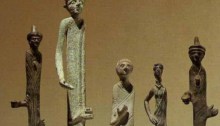
‘Ombra della sera’, or ‘evening shadow’, is the name usually used to describe a distinctive bronze votive recovered from the region of Volterra (Etruscan Velathri, Roman Volaterrae) first exhibited in the early 18th century. The thin, elongated figure, made during the 3rd century BC, is most well-known for inspiring the work of the Swiss artist…

‘Tap and Pray’

Welcome to our blog! To start us off, here’s a link to a fascinating news story about the economy of votives in modern-day Sri Lanka, where the custom of offering prayer money in temples has apparently contributed to a coin shortage. I’d really like to know more about the Central Bank’s suggestion that worshippers now…